RAG or Fine-Tuned? How We Helped Our Client Choose
A Real Customer Case Study on Making the Right AI Call.
A few months ago, one of our retail clients approached us with a crystal-clear objective:
"We want to launch an AI assistant that actually helps customers — not just one that looks impressive in presentations."
They had tried basic chatbots before. FAQs. Predefined conversation flows. Nothing really delivered meaningful results. This time, they were serious about creating something that truly works — genuinely helpful, on-brand, and scalable.
We were excited about this project. But before diving into prompt engineering, system integrations, or UI design, we faced the most critical foundational decision:
Should we go with a fine-tuned model or use RAG (Retrieval-Augmented Generation)?
This question surfaces in virtually every AI project we undertake. And the answer isn’t always straightforward — it depends on context, scale, and what “intelligent” truly means for that specific business.
Step 1: Map the Real Use Cases
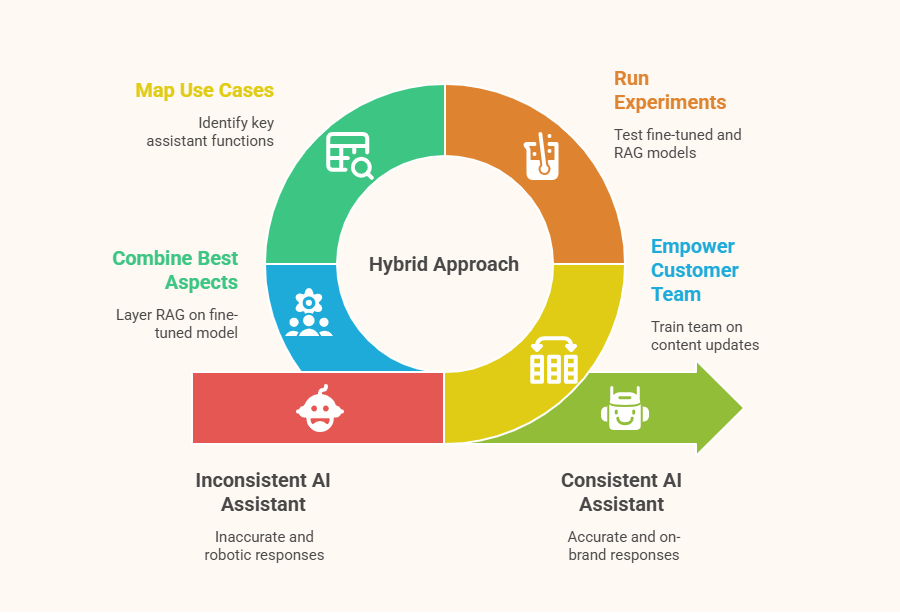
We didn't start with technology. We started with what the assistant needed to accomplish :
- Answer product and policy questions
- Provide size and style recommendations
- Adapt to ongoing promotions and inventory changes
- Reflect the brand’s voice and values
- Build trust — especially regarding returns and refunds
This gave us two distinct categories:
Repetitive, structured, tone-sensitive responses
Example: “What’s the difference between slim fit and relaxed fit?” These required
consistency, fluency, and brand voice alignment.
Factual, dynamic, continuously updated information
Example: "Can I exchange an item from the Holiday sale?" These demanded accuracy, source
grounding, and real-time updates.
Step 2: Run Experiments — and Observe What Breaks
We built two prototypes:
- Fine-Tuned Model trained on historical chat data and brand style guides
- RAG Agent connected to a vector database of product documentation, policies, and promotional details
Here's what we discovered:
What Worked Well:
- Fine-tuned bot sounded perfectly on-brand but generated outdated information — like obsolete return policies
- RAG bot provided accurate answers but sometimes sounded robotic or overly formal
The Challenges:
- Fine-tuned was fast and smooth but retraining was expensive for every change
- RAG was easy to update via document uploads but required solid chunking and search optimization
Step 3: Combine the Best of Both Worlds
Ultimately, we proposed and implemented a hybrid approach :
- Fine-tune the model on brand voice, product categories, and conversational patterns
- Layer RAG on top to fetch live data: returns, discounts, FAQs, shipping timelines
This approach allowed the AI assistant to "speak like the brand"while thinking with fresh information.
Now when a customer asks about returning a Holiday purchase, the assistant pulls the latest return policy from a document updated last night — and responds in a tone that sounds just like their favorite store associate.
Step 4: Empower the Customer's Team
We didn't stop at delivery.
We trained the client's team on:
- Updating their RAG content within minutes (via a user-friendly Knowledge Base)
- Triggering re-fine-tuning only when necessary (e.g., seasonal tone changes)
- Monitoring AI performance and feedback loops
Result? They now manage the AI assistant like a product — not just a support tool.
Our Decision Framework
This project reinforced a framework we frequently use when guiding customers:
| Ask Yourself… | If Yes, Go With… |
|---|---|
| Do you need strong tone + structure? | Fine-tuning |
| Does your information change frequently? | RAG |
| Do you want source-traceable answers? | RAG |
| Is retraining costly in your environment? | RAG |
| Want the best of both worlds? | Combine both |
Key Takeaways
Helping customers choose between RAG and fine-tuning isn’t about showcasing technical prowess — it’s about being clear about goals, constraints, and what "intelligent AI" means in the real world.
At PromptX, we’ve done this enough to know: it’s rarely about picking one approach. It’s about designing a system that evolves with your business.
Your data tells the truth. Your brand tells the story. Great AI brings both together.
Want us to help you decide what’s right for your use case? Let’s design something intelligent — together.